


How to Defer Capital Gains Tax When Selling Rental Property (Without Becoming a Landlord Again)
Most rental owners only see two options when they sell: pay a six-figure tax bill or buy another rental and stay a landlord. There's a third.
Selling a rental property forces two decisions at the same time.
The painful tax hit.
Federal capital gains, depreciation recapture, and state taxes can pull $200K to $300K off the closing statement on a $1 million sale.
The painful trade-off.
Continue managing a rental for years to come, which means more of the same tenant headaches, vacancies, and 2 a.m. maintenance calls that you've been dealing with all along.
But there is a third option, and the market for it has been growing fast. Landlords have moved $8.41 billion of equity into it in 2025, a 49% jump from $5.66 billion in 2024. Mountain Dell Consulting projects 2026 will reach $10 to $11 billion, nearly double the 2024 figure.
That third path is a 1031 exchange into a Delaware Statutory Trust, or DST.
A 1031 exchange is a section of the federal tax code that lets real estate investors sell an investment property and reinvest the proceeds into another one without paying capital gains tax in the year of the sale. A DST is one type of replacement property that qualifies under those rules. Together, the two do three things at once:
Tax deferral.
Capital gains, depreciation recapture, and state tax can all be deferred when the exchange is structured correctly.
Passive ownership.
The DST sponsor handles property management, leasing, financing, and reporting. Active landlord responsibilities end completely.
Monthly income.
Investors hold a beneficial interest in institutional-grade real estate and have the potential for monthly distributions as a fractional owner of the property. They may also benefit from potential capital appreciation when the property is sold at the end of the hold period.
The strategy has been IRS-recognized since 2004, but most rental owners have never been shown it exists, partly because DSTs sit at the intersection of tax law and securities regulation, where most CPAs and real estate brokers cannot discuss them directly.
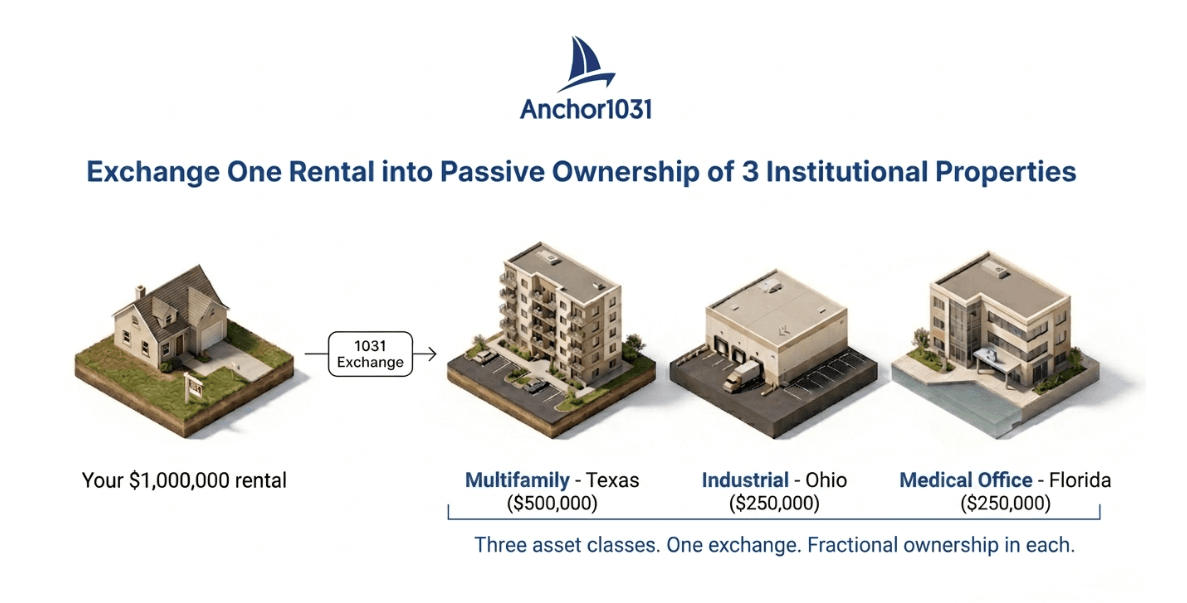
How a 1031 Exchange Into a DST Works
Section 1031 of the federal tax code allows real estate investors to defer capital gains and depreciation recapture tax when they sell investment property and reinvest the proceeds into "like-kind" replacement property. The strategy has existed since 1921 and remains one of the most widely used real estate tax deferral tools.
The phrase "like-kind" trips up a lot of investors. Many assume it means a rental house has to be exchanged for another rental house, or a duplex for another duplex. That is not what the IRS means. For real estate, "like-kind" just means real property held for investment or business use. The asset classes can be completely different. You can exchange:
- A rental house into an industrial warehouse
- Raw land into a rental property
- An apartment building into a medical office
- Your single-family rental into a DST holding any type of real estate asset, such as multifamily, industrial, retail, self-storage, and even mineral rights tied to oil and gas production within the Permian Basin
As long as both sides are real estate held for investment or business use (not your primary residence), the exchange qualifies.
The traditional 1031 path and its friction
A traditional 1031 exchange (without a DST) runs on two strict IRS deadlines: 45 days from the sale to identify a replacement property in writing, and 180 days total to close on it. Combined with a competitive real estate market and the same landlord life waiting on the other end, the whole process is stressful.
- Find and formally identify a replacement property within 45 days. Less than seven weeks. No extensions for weekends, holidays, weather, or illness. You are competing against other buyers in a live market, running due diligence, and lining up financing along the way.
- Close on it by day 180. If your identified deal falls through (failed due diligence, financing issues, seller pulling the listing), you have to close on a different property within the same window. You cannot identify a new one after day 45.
- Then you are a landlord again. Leasing, maintenance, tenant issues, taxes, insurance. Same business you were trying to step away from.
Finding the right replacement property within those windows is the hardest part. For investors who are ready to step away from active management, a DST is often the primary choice, not a backup. They want passive income, no tenant calls, and the freedom to enjoy life without the demands of being a landlord, all while still deferring the tax.
Sell your property
QI holds your sales proceeds
Identify and close on one or several DST properties in the Anchor1031 marketplace
Enjoy tax deferral and potential for monthly income and capital appreciation
How a DST changes the picture
A Delaware Statutory Trust (DST) is an IRS-recognized 1031-eligible vehicle. Under a 2004 IRS ruling, beneficial interests in a properly structured DST qualify as like-kind real estate for 1031 purposes. The trust holds institutional-grade property (multifamily, industrial, retail, self-storage, medical office, hospitality), and investors purchase fractional beneficial interests rather than the property itself. The DST sponsor identifies and acquires the property, structures the financing, and handles ongoing management.
Because the property is already identified and acquired by the sponsor, investors close into pre-identified replacement property within the 45/180-day windows without searching, negotiating, or financing it themselves. After closing, investors may potentially receive monthly distributions, benefit from depreciation passed through from the property, and participate in any capital appreciation when the property is sold at the end of the hold period. For a deeper look at how the structure works, see what is a DST and the Delaware Statutory Trust complete guide.
Typical minimums range from $25,000 to $100,000 per DST, which makes it possible to spread a single 1031 exchange across multiple properties rather than putting the entire reinvestment into one replacement. The free 1031 Field Manual covers the 45/180-day timing rules, qualified intermediary requirements, partial-exchange mechanics, debt-replacement rules, and the questions investors typically ask before they sell.
How to Structure the Exchange for Full Tax Deferral
To defer the entire tax in a 1031 exchange, two rules have to be met. Breaking either one does not kill the exchange. It just means partial deferral, with the shortfall (called "boot") taxed in the year of the sale.
Reinvest 100% of the equity
All net sale proceeds must go into the replacement DST(s). Cash held back is taxed as "cash boot."
Match or exceed the debt
Replacement DSTs must carry at least as much debt as the property you sold. A shortfall is taxed as "mortgage boot."
Rule 1: Reinvest 100% of the net sale proceeds
If you sell for $1,000,000 and net $850,000 after closing costs, the full $850,000 has to flow into the replacement DST(s). Any cash held back is called "cash boot" and is taxable in the year of the sale at the same capital gains, depreciation recapture, and state tax rates that would have applied to a straight sale.
Rule 2: Match or exceed the debt level
If the property you sold carried a $400,000 mortgage paid off at closing, the replacement DST(s) must hold at least $400,000 of debt combined. If the new debt is lower, the difference (called "mortgage boot" or "debt relief") is taxable. Most DSTs offer leveraged structures, typically at 40-60% loan-to-value, specifically to make matching the debt requirement straightforward.
Partial deferral is allowed
You don't have to meet both rules in full. The portion that meets them defers the gain associated with it; only the boot is taxed. An investor selling for $1M with $700K of gain might take $300K as cash boot, reinvest $700K into one or more DSTs, defer the gain on the reinvested portion, and pay tax only on the boot. This is useful when the investor wants some liquidity for retirement, debt payoff, or diversification outside of real estate. For the full mechanics, see the partial 1031 exchange guide.
Bonus: a fresh depreciable basis
If you sell a fully-depreciated rental and exchange into a leveraged DST (typically 40-60% loan-to-value), the new property's basis includes both your reinvested equity and the new debt. That gives you a fresh depreciation schedule on a higher basis than your old property had. The result is a renewed tax shelter against the monthly distributions you may potentially receive from the DST going forward, layered on top of the deferred capital gains.
See the DSTs available right now
Worked Example: A $1M Rental Sale
The following is a hypothetical illustration. Actual outcomes depend on individual circumstances, cost basis, depreciation schedules, applicable state law, and deal structure. Investors should consult their own tax and legal advisors before executing a 1031 exchange.
Consider an investor selling a rental property for $1,000,000, with an original cost basis of $300,000 and $200,000 of accumulated depreciation taken over the holding period. The comparison below assumes the 15% capital gains bracket and a 5% state tax for illustration. Net investment income tax of 3.8% applies if the investor's modified AGI exceeds the standard NIIT thresholds.
Selling a $1M rental: a typical tax breakdown
Estimated total: $200K to $300K to taxes
Range depends on bracket, state, and accumulated depreciation. Hypothetical illustration only.
Without a 1031 exchange
| Long-term capital gain | $700,000 |
| Federal capital gains (15%) | ~$105,000 |
| Depreciation recapture (25% of $200K) | ~$50,000 |
| NIIT (3.8%) | ~$26,600 |
| State tax (5% example) | ~$35,000 |
| Estimated total tax | ~$216,600 |
| Net proceeds after tax | ~$783,400 |
With a Full 1031 (100% reinvested)
| Cash received at closing | $0 |
| Tax owed in year of sale | $0 |
| Reinvested into DST(s) | $1,000,000 |
| Gain deferred under 1031 | $700,000 |
| Tax deferred | ~$216,600 |
Plus potential monthly distributions and capital appreciation on the $1M reinvested (not guaranteed).
The deferred tax stays deferred as long as the investor keeps the proceeds in 1031-eligible property. Investors can continue to defer indefinitely by chaining one 1031 exchange after another, including DST-to-DST exchanges. When a DST sponsor sells the property at the end of its hold period (typically five to ten years), the investor can roll those proceeds into another DST through a new 1031 exchange. The deferral compounds across decades.
If the investor holds 1031-eligible property until death, their heirs receive a stepped-up basis equal to the property's fair market value at that time. The deferred tax burden may potentially be eliminated entirely, transferring the real estate to the next generation without realizing the original gain.
A Sample of Our Current DST Offerings
Below are three of the 27 active DST offerings on our marketplace today. Each is a real property from an institutional sponsor, vetted by our broker-dealer and curated by a team that has participated in over $1.2 billion of real estate syndications and 300+ 1031 exchanges into DSTs. Year 1 yield reflects the property's existing leases as determined by the offering's issuer, not a projection of future earnings. For a side-by-side review of the major DST sponsors and how to evaluate them, see our DST Investments 2026 sponsor guide.
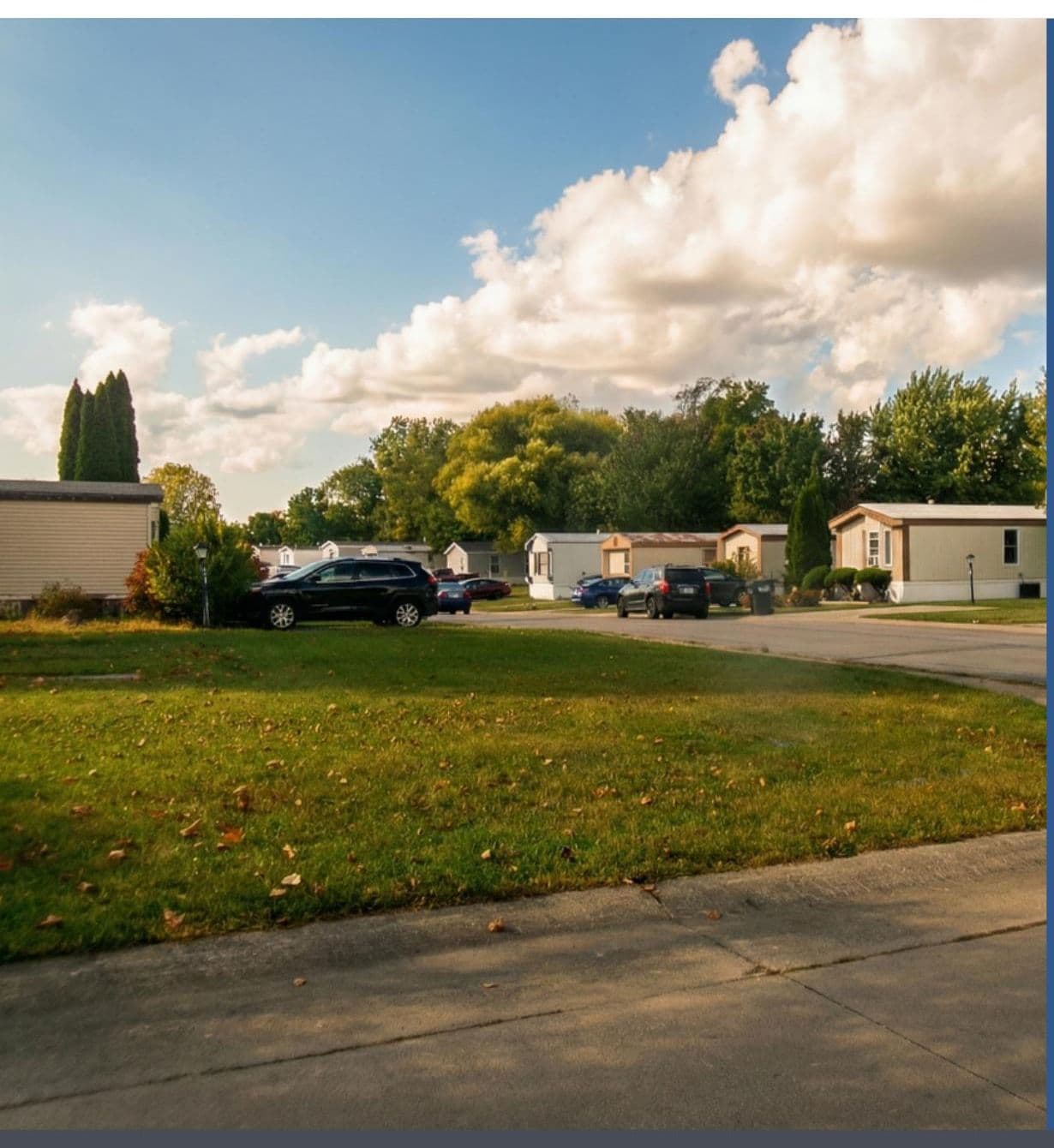
MHC Affordable Housing DST V
MHC Capital V, LLC
- Property Type
- Manufactured Housing
- Year 1 Yield
- 5.25%
- Leverage
- 40% LTV
📍 Midwest Portfolio (OH, IN, WI, MI)
View Details →

FREX DB Series I DST
Fortress Real Estate Exchange LLC
- Property Type
- Student Housing
- Year 1 Yield
- 5.00%
- Leverage
- 47% LTV
📍 Morgantown, WV
View Details →

Passco Toscana DST
Passco Companies, LLC
- Property Type
- Multifamily
- Year 1 Yield
- 4.40%
- Leverage
- 47% LTV
📍 Salem, NH
View Details →
Want to see all 27 available DSTs?
We'll send you our full current DST inventory along with the free 84-page 1031 Field Manual that helps investors spot the key DST risk factors most people miss.
Get the Full DST List ↓Year 1 cash flow figures shown reflect each property's existing leases as determined by the offering's issuer. They are not a projection of future earnings and are not guaranteed. Each estimate, along with the associated risks and material assumptions, is fully described in the property's Private Placement Memorandum (PPM). DST offerings are private placements available only to accredited investors.
See What Your Property Could Look Like as a DST
Enter your property details (sale price, mortgage balance, monthly income) and the Anchor1031 Portfolio Builder tool shows your current cash flow side-by-side with hypothetical DST options. You can see what a 1031 exchange might look like before you commit to anything.
Model Your 1031 Exchange Before You Commit
Enter your property details to compare your current rental cash flow with hypothetical DST income after a 1031 exchange.
Total rent you collect each month before expenses
Include mortgage, property taxes, insurance, HOA — everything you pay to own this property
What you expect to sell your property for
Remaining balance (enter 0 if owned free and clear)
Enter your rental income and sale price to see your property snapshot
Get the Full DST Inventory + the Free 1031 Field Manual
Submit your details and we'll send you the current DST inventory along with the 84-page Field Manual that walks through 1031 timing rules, partial-exchange mechanics, and the questions to ask before you sell your property.
Get Access to Vetted DST Properties
Plus the 84-page 1031 Field Manual covering DST risks, fee structures, and the questions every investor should ask
Prefer to talk first?

About the author
Trevor Sybertz, Partner at Anchor1031
Trevor has more than ten years of experience in commercial real estate. He previously served as a director at a national commercial real estate investment company, where he helped clients invest more than $100 million in equity across a range of asset classes. At Anchor1031, he works directly with investors completing 1031 exchanges into DSTs, TICs, and other accredited investor offerings.
Common Questions
How does a DST qualify as 1031 like-kind property?
Under a 2004 IRS ruling, a properly structured Delaware Statutory Trust qualifies as a direct interest in real estate for 1031 exchange purposes. The trust must meet specific IRS operating restrictions that limit the trustee’s ability to renegotiate leases, refinance debt, or admit new investors after closing. These restrictions are what keep the DST 1031-eligible.
What happens at the end of a DST hold period?
Most DSTs hold property for approximately five to ten years before the sponsor sells. At that point, investors typically have the option to receive their proceeds in cash and pay the previously deferred tax, or roll into another 1031 exchange (often into another DST) to continue the deferral.
Are the distributions from a DST guaranteed?
No. Distributions are not guaranteed. They depend on the property’s net operating income, debt service, and operating reserves. Most DST offering documents include a target distribution range, but actual distributions can be higher or lower.
How does Anchor1031 help with a 1031 exchange into a DST?
Anchor1031 helps accredited investors evaluate and access DST replacement property within their 1031 exchange timeline. We work with established sponsor groups with institutional track records, maintain a curated marketplace of available offerings, and provide educational tools (the Portfolio Builder, calculators, the 1031 Field Manual) so investors can understand structure and risk before investing.
What if my situation isn't right for a DST?
DSTs are not suitable for every investor or every 1031 exchange. Some situations call for direct replacement property, a Tenant-in-Common (TIC) structure, or recognizing the gain and not exchanging. The Field Manual covers when each approach is appropriate, and the Anchor1031 team can help evaluate which path fits a specific situation.
Sources
This article references the following Internal Revenue Code sections and IRS guidance.
1031 exchanges:
- IRC § 1031 (Cornell Law)
- Treas. Reg. § 1.1031(k)-1 (Cornell Law)
- Rev. Proc. 2002-22 (Tenant-in-Common safe harbor)
Delaware Statutory Trusts:
- Rev. Rul. 2004-86 (DST 1031 eligibility)
Capital gains and depreciation:
- IRC § 1 (capital gains rates)
- IRC § 1250 (depreciation recapture on real property)
- IRC § 1411 (Net Investment Income Tax)
- IRC § 1014 (stepped-up basis at death)
- IRS Publication 544 (Sales and Other Dispositions of Assets)
Disclosure
Tax Complexity and Investment Risk
Tax laws and regulations, including but not limited to Internal Revenue Code Section 1031, bonus depreciation rules, cost segregation studies, and other tax strategies, contain complex concepts that may vary depending on individual circumstances. Tax consequences related to real estate investments, depreciation benefits, and other tax strategies discussed herein may vary significantly based on each investor's specific situation and current tax legislation. Anchor1031, LLC and Quincy Wells Capital, LLC make no representation or warranty of any kind with respect to the tax consequences of your investment or that the IRS will not challenge any such treatment. You should consult with and rely on your own tax advisor about all tax aspects with respect to your particular circumstances. Please note that Anchor1031 and Quincy Wells Capital, LLC do not provide tax advice.

The information contained in this article is for general educational purposes only and does not constitute legal, tax, investment, or financial advice. This content is not a recommendation or offer to buy or sell securities. The content is provided as general information and should not be relied upon as a substitute for professional consultation with qualified legal, tax, or financial advisors.
Tax laws, regulations, and IRS guidance regarding 1031 exchanges, opportunity zone investments, and related real estate strategies are complex and subject to change. Information herein may include forward-looking statements, hypothetical information, calculations, or financial estimates that are inherently uncertain. Past performance is never indicative of future performance. The information presented may not reflect the most current legal developments, regulatory changes, or interpretations. Individual circumstances vary significantly, and strategies that may be appropriate for one investor may not be suitable for another.
All real estate investments, including 1031 exchanges and opportunity zone investments, are speculative and involve substantial risk. There can be no assurance that any investor will not suffer significant losses, and a loss of part or all of the principal value may occur. Before making any investment decisions or implementing any 1031 exchange strategies, readers should consult with their own qualified legal, tax, and financial professionals who can provide advice tailored to their specific circumstances. Prospective investors should not proceed unless they can readily bear the consequences of potential losses.
While the author is a partner at Anchor1031, the views expressed are educational in nature and do not guarantee any particular outcome or create any obligations on behalf of the firm or author. Neither Anchor1031 nor the author assumes any liability for actions taken based on the information provided herein.